

 Image 1 of 1
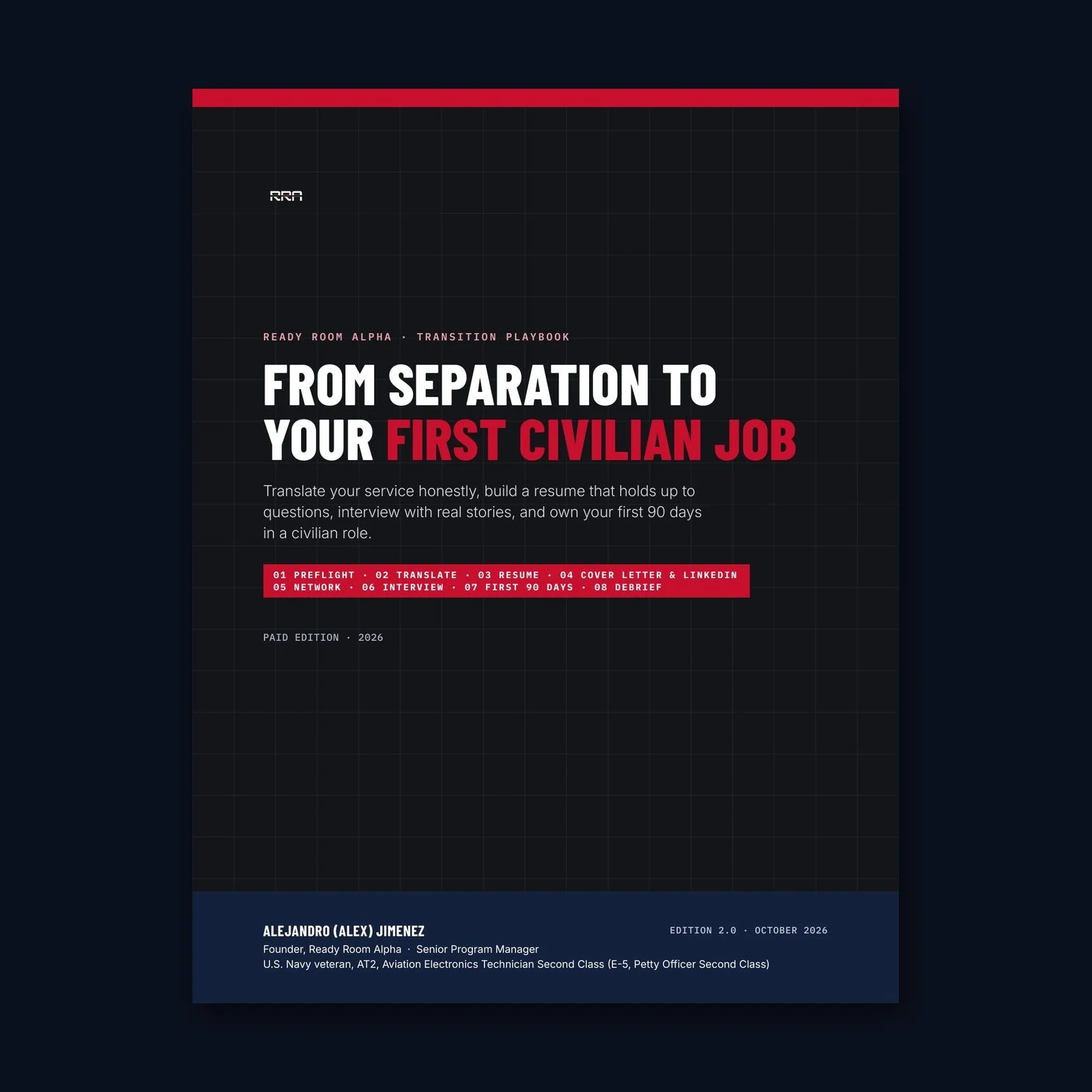
Transition Playbook: From Separation to Your First Civilian Job
$35. One downloadable PDF, 27 pages. One-time purchase. A working playbook for getting your first civilian job: pick a target role, translate your service into plain language, write a resume that holds up to questions, prepare interview stories, and plan your first 90 days.
You leave each section with something you can use: a decoded job posting, a translated skills list, resume bullets, outreach scripts, six to eight interview stories, and a 30/60/90 plan.
What's inside, by section and page
How to use it, pages 2 to 3: the standard the playbook holds you to, who it's for, and how long each section takes.
01 Preflight, pages 4 to 5: a scoring table to pick one target role, official sites for researching roles and credentials, and a worksheet to decode one real job posting.
02 Translate, pages 6 to 9: a table of common military work with civilian wording and the evidence to look for, a translation worksheet, a jargon-to-plain-language table, a worked example for an Aviation Electronics Technician, where your records live (JST and VMET), and a scope ladder so you say "led" or "coordinated" only when it's true.
03 Resume, pages 10 to 15: the bullet formula, the number test, seven fictional before-and-after bullets, a verb bank, a bullet builder, a 10-question resume FAQ, a note on federal resumes from OPM guidance, a fictional sample one-page resume, and a pre-send check.
04 Cover letter and LinkedIn, page 16: a cover letter outline, a fictional example letter, and a profile checklist.
05 Network, pages 17 to 18: four outreach scripts, a 15-minute informational interview plan, and a networking tracker.
06 Interview, pages 19 to 24: the STAR-L story method with an annotated example, a story bank, two story worksheets, a question bank of 24 common questions grouped by what the interviewer is checking, how to handle salary questions, questions you don't have to answer, questions to ask them, an interview-day checklist, and a debrief with a thank-you note template.
07 First 90 days, pages 25 to 26: how civilian workplaces differ from military ones, a 30/60/90 plan, first-week questions for your manager, and a weekly debrief.
08 Debrief, page 27: a final checklist before you apply in volume.
Who it's for: service members within about a year of separation, recent veterans, and veterans changing careers. It's written for enlisted and junior-officer experience.
Why pay for it when free help exists: use free help too. TAP and other no-cost programs are worth your time. This playbook is the work between those programs: the worksheets, the examples, and the checks you fill in for your own target job.
What it won't do: guarantee a job, a salary, or a credential. All examples are fictional. It doesn't replace official program guidance.
Format: one PDF, 27 letter-size pages, made to print and write on. Single-user license for personal use. Your download link arrives at checkout.
Who wrote it: Alex Jimenez, Founder, Ready Room Alpha. AT2, Aviation Electronics Technician Second Class (E-5, Petty Officer Second Class), U.S. Navy. Civilian job: Senior Program Manager.
Ready Room Alpha is not affiliated with or endorsed by the U.S. Navy, the Department of Defense, or the U.S. government.